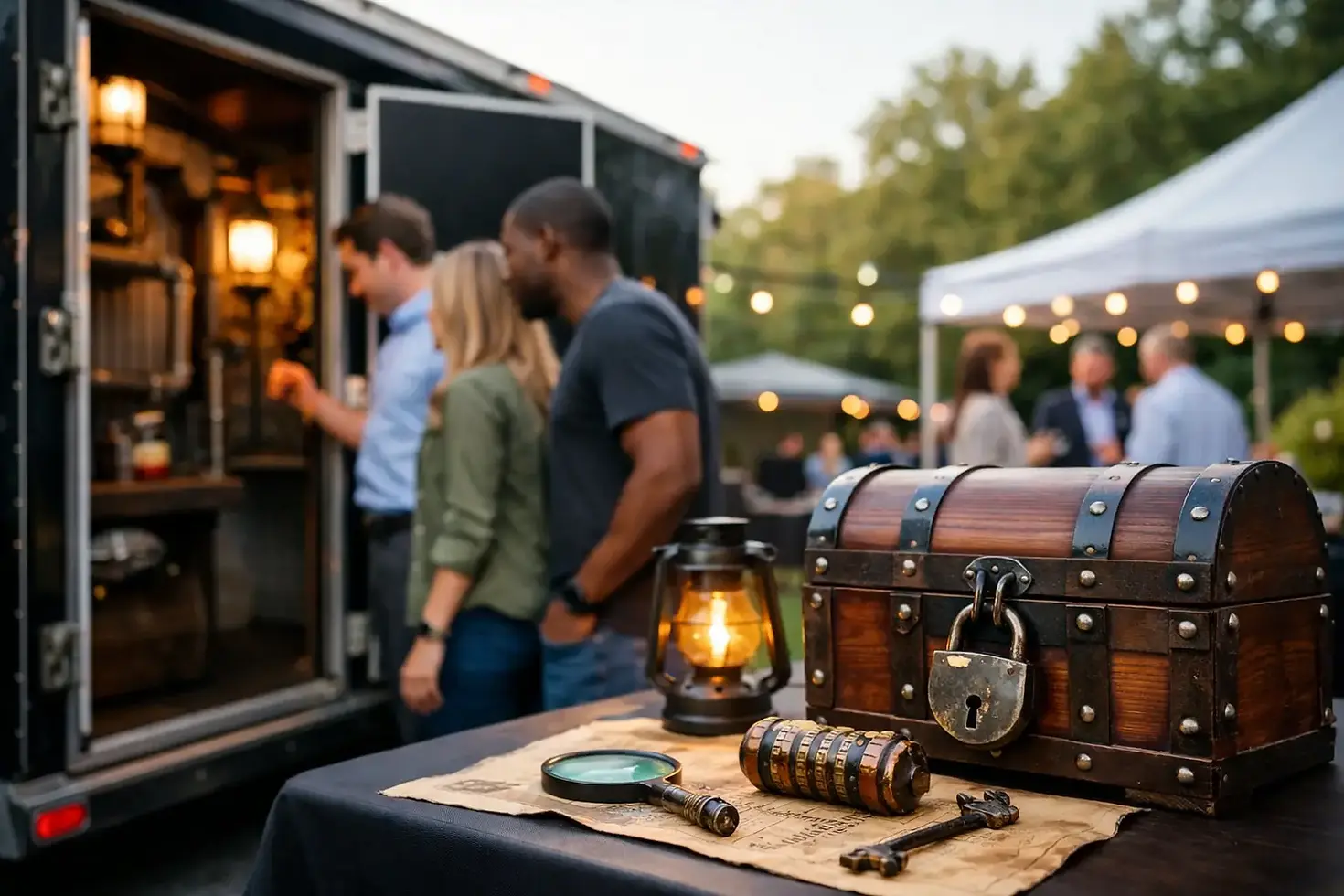
Why a Mobile Escape Room Works for Events
- 5 days ago
- 6 min read
When you need an activity that gets people talking, thinking and working together without sending everyone off-site, a mobile escape room solves a very real event problem. It brings the pace and immersion of an escape game directly to your venue, which means less friction for organisers and a far better fit for modern conferences, office events, team-building days and large group programmes.
For event planners and internal teams, that matters. Time is tight, venues are varied, guest numbers shift, and no one wants an activity that creates more logistics than value. A well-delivered mobile format keeps the experience high while keeping the process straightforward.
What is a mobile escape room?
A mobile escape room is a professionally delivered escape game experience that is transported, set up and hosted at your location. Instead of sending your group to a fixed venue, the game comes to your office, conference centre, hotel, university campus or event space.
That sounds simple, but the delivery quality is what separates a genuine event solution from a novelty prop. A strong mobile format is designed around portability without losing structure, challenge or immersion. It should work within real-world venues, run to schedule, and give participants a clear, engaging experience from briefing to final reveal.
In practice, that can take different forms. Some events suit pop-up escape rooms with themed sets and timed team rotations. Others need tabletop escape challenges for larger numbers, office takeover games that use the workspace itself, or puzzle-based formats built around networking and conference agendas. The right option depends on your audience, venue and timetable.
Why mobile escape room events suit modern business events
The biggest advantage is flexibility. Fixed-site escape rooms are enjoyable, but they often come with limits around travel, capacity, timing and accessibility. For corporate organisers, those limits can become expensive very quickly.
A mobile escape room removes much of that pressure. Your attendees stay on-site, which protects the flow of the day and reduces downtime. It also allows the activity to fit around meetings, breakout sessions, catering and speaker schedules rather than forcing the whole agenda to work around an external booking.
That flexibility is especially valuable for multi-use venues. Hotels, conference spaces and offices are rarely blank canvases. There are room turnarounds, AV requirements, registration desks, refreshments and senior stakeholders to consider. A portable escape format that has been built for live events can adapt to those realities.
There is also the engagement factor. People are far more likely to commit to an activity when it is right in front of them, well hosted and easy to join. You are not asking them to travel across a city, split into awkward transport groups or navigate a venue they have never visited before. You are giving them a structured shared experience exactly where they already are.
The real value goes beyond entertainment
A mobile escape room works because it creates active participation. Guests are not watching a performance or sitting through another passive session. They are solving problems, sharing information, spotting patterns and managing pressure together.
That makes it particularly effective for team building. Strong escape games naturally bring out communication styles, leadership habits and collaborative behaviour. One team may win through calm analysis, another through fast delegation, and another through sheer persistence. The format gives people a reason to contribute, even if they would usually stay quiet in a more formal group setting.
For HR teams and event leads, this has practical value. It is a fresh, energised activity, but it also supports broader objectives around connection, morale and cross-team interaction. New starters can mix with established teams. Different departments can work together without the stiffness of a traditional workshop. Senior staff can join in without the session feeling overly corporate.
That said, the format is not magic on its own. If the puzzles are weak, the host lacks control, or the timing is poor, the energy drops quickly. Good delivery matters as much as the concept.
Choosing the right mobile escape room format
Not every event needs the same type of game. This is where experienced providers add real value, because format choice affects both participant experience and operational success.
If you want maximum immersion for smaller groups, a pop-up room format can be ideal. It creates a strong sense of occasion and gives teams that classic escape-room pressure. It suits team away days, hospitality settings and premium internal events where atmosphere matters.
If your group is larger, a scalable tabletop or multi-team challenge may be the better fit. These formats can handle high volumes more efficiently and keep gameplay moving without long waiting times. For conferences and all-company events, that often makes more commercial sense than trying to rotate everyone through a single room setup.
Office takeover games sit somewhere in the middle. They can work brilliantly when you want to transform a familiar environment into something more interactive, especially for workplace engagement days. The trade-off is that they require thoughtful planning around space use and business continuity.
Outdoor and campus-wide puzzle games also have their place, particularly for universities, summer events and large mixed-audience gatherings. They offer scale and movement, but they are more dependent on weather, site layout and crowd management.
What organisers should look for from a supplier
A mobile escape room provider should do more than turn up with a box of props. For a business event, you need a delivery partner that understands logistics, timing, audience management and venue constraints.
First, look at operational clarity. You should know how long setup takes, what space is required, how teams rotate, how many people can take part, and what happens if schedules change on the day. If those answers are vague, the risk sits with you.
Second, look at facilitation. Professional hosts make a significant difference. They set the tone, manage energy, explain the rules clearly and keep the experience moving. This is particularly important for mixed groups where some participants may be hesitant at first.
Third, consider scalability. A format that works brilliantly for 20 people may struggle with 200 unless it has been designed properly. Large-group events need structure, pacing and enough gameplay density to keep people involved.
Finally, assess how bespoke the experience can be. Some events benefit from branded content, tailored messaging or themes aligned to the audience. That is not essential every time, but it can elevate the activity when you want a stronger connection to your event objectives.
Mobile escape room planning tips for corporate events
The best results usually come from aligning the game with the event rather than treating it as an afterthought. Start with the practical question: what role should the activity play? It could be an energiser, a team-building headline, a networking tool or part of a wider conference programme. Once that is clear, the right format becomes easier to choose.
It also helps to be realistic about your venue. Ceiling height, access times, room shape, background noise and power availability all affect setup and delivery. A dependable supplier will ask these questions early because they know small details can shape the final experience.
Group composition matters too. If your audience includes a wide mix of personalities, seniority levels or confidence levels, the game needs to be inclusive in how it is introduced and hosted. Challenge is good. Confusion is not.
And while budget always matters, the cheapest option is rarely the best benchmark. For live event experiences, value comes from professional delivery, reliable hosting and a format that genuinely works in your environment. A game that underwhelms participants or creates event-day stress is expensive in all the wrong ways.
Why the delivery model matters as much as the game
For many buyers, the appeal of a mobile escape room is convenience. That is fair, but convenience on its own is not enough. The real benefit is having a complete, managed experience delivered by a team that knows how to make it work on-site.
That includes transport, setup, hosting, reset between sessions and pack-down. It includes adapting to venue realities without compromising the participant experience. It includes being polished enough for client-facing events and flexible enough for internal team days.
This is where specialist providers stand apart. Escape Game Events, for example, focuses on on-site delivery across the UK with formats built for corporate and large-scale use, not just one-off entertainment. That specialist approach gives organisers more confidence because the event model has already been tested in real venues, with real time pressures and real audience variety.
When the experience is well chosen and well run, a mobile escape room does more than fill an agenda slot. It gives people a reason to collaborate, a memorable shared reference point, and a live activity that fits the realities of business events rather than fighting against them.
If you are planning an event and want something interactive without the usual venue and travel complications, start by asking a simple question: will this be easy for people to join and worthwhile once they do? A strong mobile format answers yes to both.


